

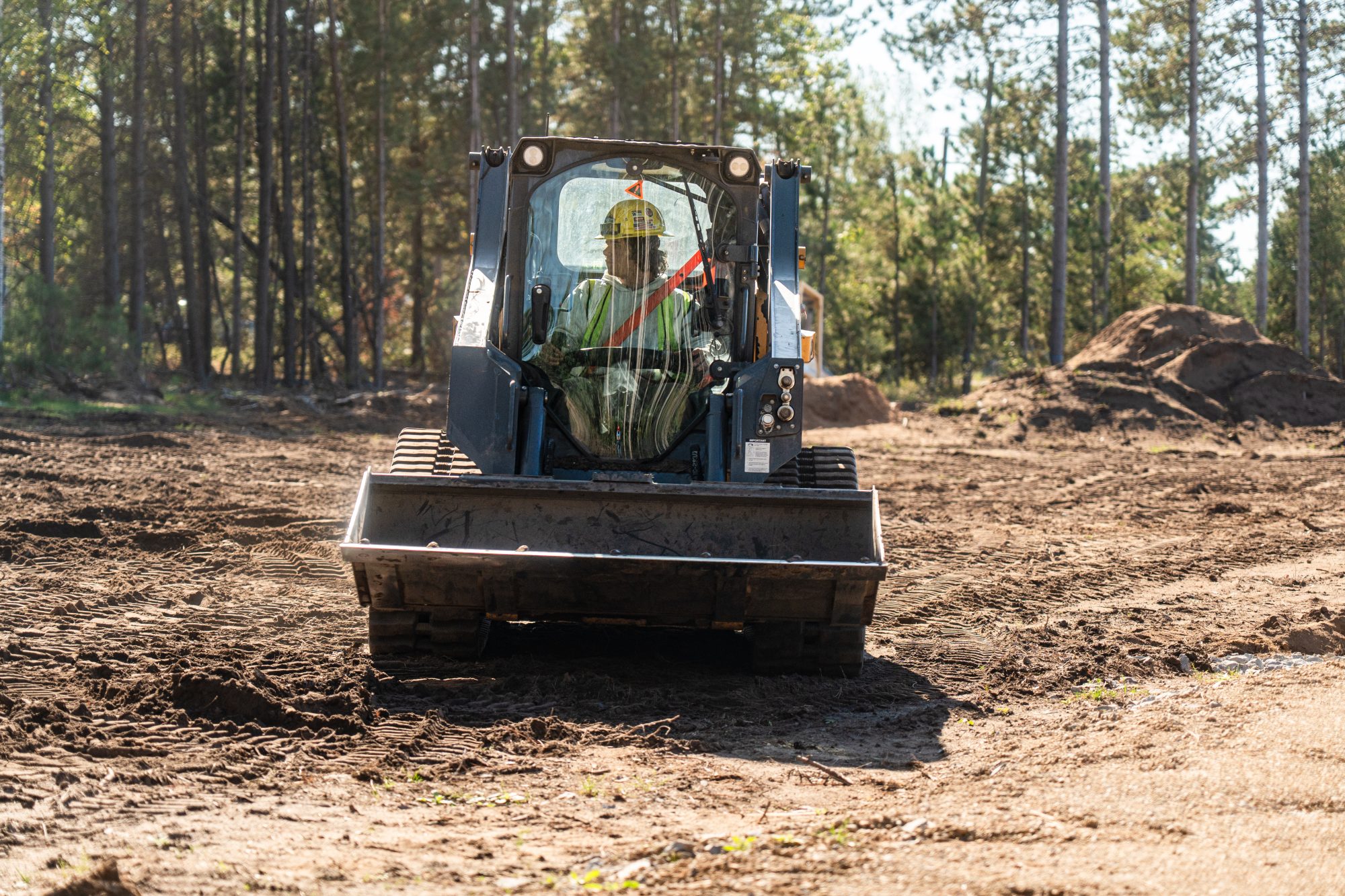
You are not going to learn to run an excavator from a textbook. You learn it by climbing into the cab, putting hands on the controls, and working through a real cut while an instructor who has spent a career in the field stands close enough to talk you through every move.
That is the entire idea behind the Heavy Equipment Operations Certificate Level I program at North Country. Hours in the equipment over hours in a classroom. Experienced operators teaching incoming operators. The format is built so that the first time you actually run a piece of equipment is not on the first day of your first paying job.
North Country is in Escanaba, Michigan — close enough to most of Wisconsin that students from across the state regularly make the trip, including from Marinette, Green Bay, Wausau, and points farther south. The drive-time table below is for anyone running the math on whether the program fits their commute.
What you actually do here
The program is structured around equipment time. The fleet includes excavators, dozers, loaders, motor graders, and the other production machines that show up on real job sites. Time on each piece is scheduled into the program rather than left to who grabs the seat first.
Instructors are working operators and former working operators. Their job during training is not to walk you through chapter summaries. It is to teach what works on a real cut, on a real grade, in real weather — including the kind of edge-case judgment that does not appear in any manual and that you would otherwise pick up the hard way on a payroll job.
By the end of the certificate, students are prepared for entry-level operator roles with contractors, road agencies, aggregate operators, and forestry-related employers across the Upper Midwest. Some go directly into operator positions; others continue toward apprenticeship-track work where the credential and equipment hours count for something the day they walk in.
Full program details, current schedule, and tuition live on the Heavy Equipment Operations Certificate Level I program page.
What students say
Hayden Avery
“I recently had the privilege of attending the North Country Heavy Equipment Operator training in Escanaba MI, and I must say, it was an absolutely phenomenal experience.”
— Hayden Avery
Dave Zdroik
“Don, Bob, and Dennis were all exceptional at conveying not only the knowledge they have but how to use it in real world situations. Safety first always. They also have infectious positive attitudes. I would recommend this to anyone looking to expand their skills list.”
— Dave Zdroik
John Helms
“Top notch training with very knowledgeable instructors. I went through the course at 18 years old and I wasn’t treated like I’m the new guy who knows nothing. It’s not a long class but you gain tons of experience, knowledge, and confidence.”
— John Helms
Mike Dombrowski (hiring employer)
“We have had several operators come from this school and couldn’t be happier! A wide variety of equipment, top notch instructors that teach the RIGHT way. Thanks guys keep up the great work!!”
— Mike Dombrowski
More reviews live on the testimonials page.
The instructor approach
If there is a single thread running through what students say about the program, it is that the instructors are the program. Don, Bob, Dennis, Emil — these names show up across the reviews because students remember the people who taught them more clearly than they remember any module or syllabus.
The expectation, set on day one, is that you are training to operate equipment safely and effectively. Not to pass a test about operating equipment. That distinction shapes the whole experience: instructors stay close, demonstrate before they explain, and treat questions as part of the work rather than an interruption to it.
Drive time from Wisconsin
North Country sits in Escanaba, Michigan, in the Upper Peninsula. For most of Wisconsin, the drive is shorter than people assume — especially from the northern half of the state. The table below uses approximate driving times based on standard mapping estimates.
| Wisconsin city / area | Approx. drive time | Approx. distance |
| Marinette, WI | ~50 minutes | ~45 miles |
| Florence County, WI | ~1 hour | ~50 miles |
| Green Bay, WI | ~2 hours | ~100 miles |
| Appleton, WI | ~2.5 hours | ~125 miles |
| Wausau, WI | ~2.5 hours | ~150 miles |
| Eau Claire, WI | ~4 hours | ~225 miles |
| Madison, WI | ~5 hours | ~280 miles |
| Milwaukee, WI | ~5.5 hours | ~290 miles |
For students outside daily commuting range, off-site lodging during the program is a common arrangement. Admissions can walk through the current options that have worked for previous out-of-state students.
The Wisconsin heavy equipment job market
Construction equipment operators are consistently on Wisconsin Department of Workforce Development lists of in-demand trades. The Bureau of Labor Statistics tracks the role under SOC code 47-2073, and Wisconsin maintains substantial employment in the category across road construction, aggregate, and utility sectors.
A trained operator with a recognized credential and real equipment hours walks into the hiring conversation in a different position than a candidate with neither — for entry-level operator jobs with general contractors as well as for apprenticeship-track positions that lead to union operator wages.
For current Wisconsin wage and employment data, the BLS Occupational Employment Statistics page for construction equipment operators is the authoritative source, alongside the Wisconsin DWD Job Center listings.
Tuition, financial aid, and GI Bill
Tuition for the Heavy Equipment Operations Certificate is detailed on the tuition and program costs page. Financial aid eligibility, payment plans, and GI Bill / VA benefits are reviewed at application. Veterans and active-duty service members should contact admissions directly — a meaningful share of past students have used VA benefits to fund their training.
For students considering relocation or short-stay housing during the program, admissions can walk through lodging arrangements that have worked for past out-of-state students.
Frequently asked questions
Can Wisconsin residents enroll at North Country?
Yes. The school accepts students from any state. Wisconsin residents regularly attend the heavy equipment program.
How long is the heavy equipment program?
The Heavy Equipment Operations Certificate Level I runs as a focused, hands-on training program. Contact admissions for current start dates and seat availability.
Will my credential be recognized by Wisconsin employers and unions?
The certificate is recognized by employers across the Upper Midwest. Specific union or apprenticeship credit varies by local — confirm with the Wisconsin contractor or union you are targeting before enrolling.
Where do North Country graduates work?
Graduates work for general contractors, road agencies, aggregate operators, and forestry-related employers across Michigan, Wisconsin, and the broader Upper Midwest.
Is housing available for out-of-state students?
Past students have used off-site lodging during the program. Admissions can walk through the current options at the time of application.
How do I apply?
Visit the Apply for the heavy equipment program page or Talk to admissions. Past students describe the intake process as straightforward and well-organized.
Train with us
North Country runs a hands-on heavy equipment program with working operators teaching it. Most of Wisconsin is within practical driving range, and the application process is short.