

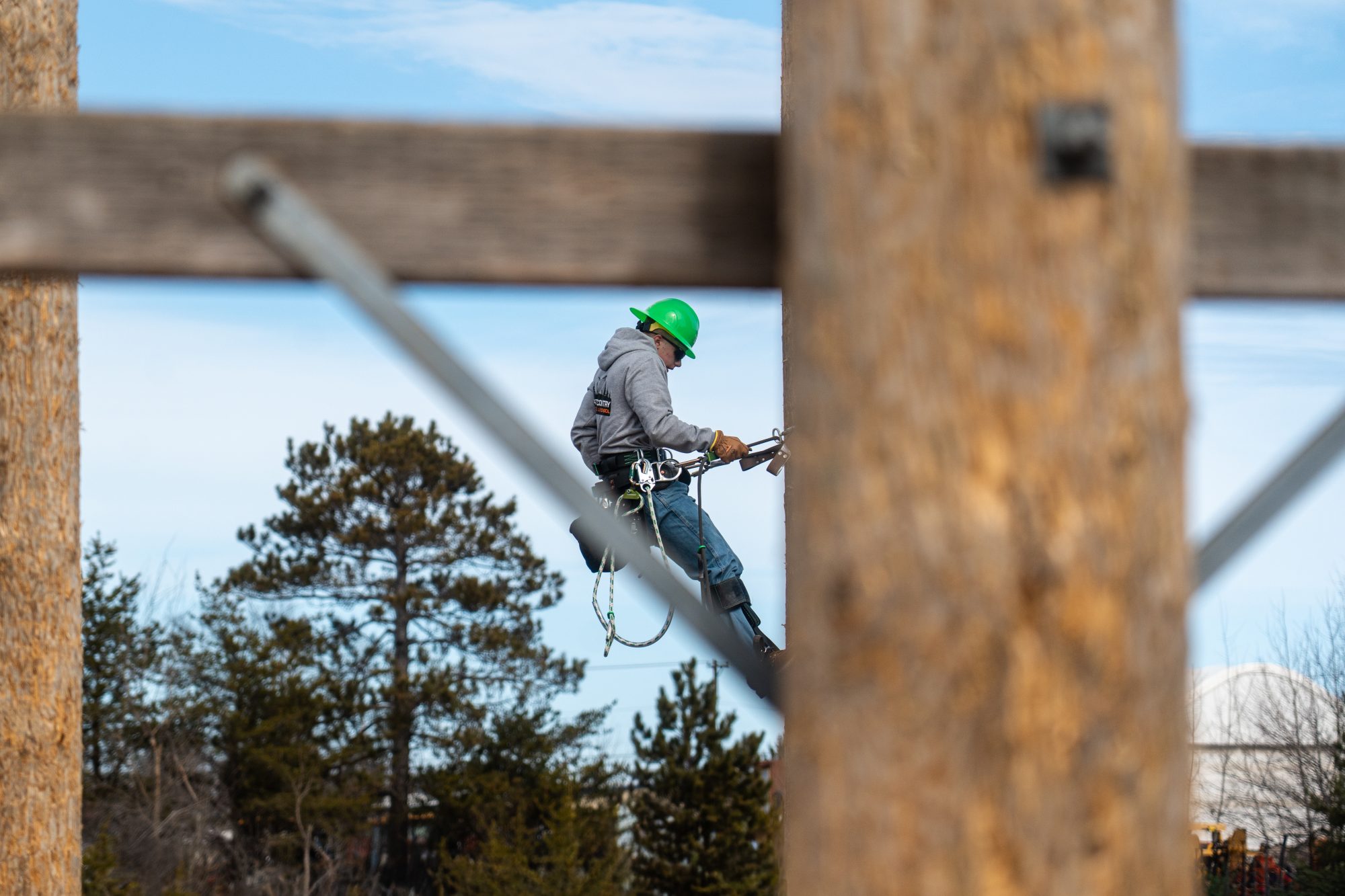
Linework pays well. The work is outdoors, year-round, dangerous if you’re careless, and full of people who have done it for thirty years and would not do anything else.
If you live in Wisconsin and you’re thinking about it, the questions are usually the same: what does it pay here, how do you actually get in with no experience, and which school doesn’t waste your time.
Most of this page is about the trade and the path in. Our school is on the table near the end, after you know what you’re looking for.
What linework is actually like, day to day
Linemen build and maintain the wires that carry power from substations out to homes, farms, and businesses. Most of that work is distribution — the wooden poles you drive past every day. Some of it is transmission — the steel towers that move bulk power across the state. Most students aim for distribution first. That’s where the apprenticeships are.
The work is outdoors, year-round, in Wisconsin weather. It’s physical. You climb poles in a tool belt that runs 30 to 40 pounds. It’s mental — most of the equipment you handle can kill you if you get casual about it. And it’s on-call. When the lights go out at 3 AM in February during an ice storm, a crew is going out to put them back on. That’s part of the job.
What keeps people in the trade isn’t one thing. The pay is real. The work is visible — you can drive past a line you ran. Crew culture is tight in a way most modern jobs aren’t. And the path keeps going. Foreman, general foreman, utility supervisor, or you stay a journeyman for forty years and never get bored.
What linemen actually earn in Wisconsin
Pay is usually the first question. Roughly what Wisconsin pays right now:
First-year apprentices generally earn somewhere in the mid-$20s to mid-$30s an hour, depending on the local and the employer. Apprentice scale is set as a percentage of journeyman scale, usually starting around 60 percent and stepping up each year of the apprenticeship.
Journeyman scale in Wisconsin generally runs in the mid-$40s to mid-$50s an hour at base. Storm overtime, callouts, and per-diem on out-of-area work push real earnings well above that. Clearing six figures a year at journeyman level with steady work is normal.
Plan on the apprentice number, not the journeyman number. Year one is a real income — usually a step up from most entry-level jobs around here — but it isn’t the number you see in social-media posts about linemen clearing $200K. That number is journeyman scale plus storm work plus a lot of hours. It’s a path, not a starting line.
For current Wisconsin-specific numbers, the BLS page for Electrical Power-Line Installers and Repairers is the source. Local rates — IBEW Local 14 in Milwaukee, Local 953 in northern Wisconsin, or the utility you’d work for — are published and worth checking against the BLS data.
How someone with no experience actually breaks in
There are three ways into the trade. They aren’t all equal.
1) Direct IBEW apprenticeship application
Apply straight to an IBEW Outside Construction apprenticeship. The JATC takes applications, runs aptitude testing, and ranks people. Get in and you start a four-year apprenticeship and earn while you train.
It’s the cheapest path on paper. It’s also the hardest to get into. A lot of people apply for a small number of slots, and the ones who get in directly usually have prior trade work, prior climbing, or a real connection inside the local.
2) Military experience that translates
Veterans coming out of construction battalion, prime power, or electronics roles often have a real edge. The GI Bill helps. Climbing or electrical work in service helps more. If you’re post-service and looking at the trade, talk to a JATC and to a school before assuming a specific path — the GI Bill works at most pre-apprenticeship schools, and your time in service may already count for something.
3) Pre-apprenticeship school
For everyone else — no prior trade, no military, no inside line — pre-apprenticeship school is the realistic path. It’s the one most successful linemen took. You show up to apprenticeship applications and contractor interviews with the credentials, climbing hours, and a CDL already done. The conversation skips “can this person be trusted on a pole” and goes straight to “when can you start.”
What to look for in a lineman school
A few things matter more than the brochure suggests.
-
How much of the program is hands-on. Climbing, equipment time, real PPE drills. Ask for a percentage. If the program can’t answer, that’s the answer.
-
OSHA-10 included. Most utility employers want it before a new hire can step on a job site.
-
Pole Top Rescue certification. Required before most employers will let an apprentice climb anything energized.
-
Class A CDL inside the program, not on top of it. Programs that treat the CDL as a prerequisite send students to another school for the truck license. Time and cost add up.
-
Instructors who have worked the trade, not just taught it. The judgment calls that keep people alive aren’t in any textbook.
-
A straight answer about where last year’s graduates landed. Vague answers are a flag.
How North Country’s 16-week program stacks up
Against the criteria above, here’s the program we run — the Electrical Line Technician program.
Sixteen weeks long, with 85 percent of the time scheduled as hands-on. You walk out with OSHA-10 (General Industry and Construction), Pole Top Rescue certification, and a Class A CDL. The CDL is inside the program, not a separate prerequisite — and that’s the part that changes the math against most other schools.
Climbing time is in the schedule from early on, not stuffed into the last few weeks. The program also includes hands-on time on the heavy equipment that line construction crews actually use, so apprentice candidates show up ready to run the support machines too.
After the 16 weeks, students go in three directions: IBEW JATC applications, utility direct-hire programs, and line construction contractors. Apprenticeship credit for the program varies by local — confirm with whichever IBEW or utility you’re targeting before enrolling, and get the credit decision in writing rather than implied.
From students who came through the program
Students rate the program five stars across Facebook and Google. Two that get at the lineman experience specifically:
“This is a great school to attend, the biggest part for me was the hands on learning and operating with experienced journeyman lineman with you every step of the way. An amazing experience and the need to know for the trades. I learned more than I expected and loved going into class every day. Thanks to all the amazing staff for everything they do!”
— Josh Steadman
“It was a very enjoyable, and very educational experience, I learned a lot, also took the Class A CDL with them and it’s a very unique opportunity to take both classes. Live in their off-site lodging, and make lots of new people. The instructors for both classes are phenomenal and I’m glad that I took both.”
— Tim Strangfeld
More on the testimonials page.
Getting to the school from Wisconsin
The school is in Escanaba, Michigan, in the U.P. From most of Wisconsin, the drive is shorter than people guess. Estimates:
| Wisconsin city / area | Approx. drive time | Approx. distance |
| Marinette, WI | ~50 minutes | ~45 miles |
| Florence County, WI | ~1 hour | ~50 miles |
| Green Bay, WI | ~2 hours | ~100 miles |
| Appleton, WI | ~2.5 hours | ~125 miles |
| Wausau, WI | ~2.5 hours | ~150 miles |
| Eau Claire, WI | ~4 hours | ~225 miles |
| Madison, WI | ~5 hours | ~280 miles |
| Milwaukee, WI | ~5.5 hours | ~290 miles |
Students outside daily commuting range usually stay in off-site lodging during the 16 weeks. Admissions can walk through the current options at the time of application.
What it costs and how students pay for it
Current tuition is on the tuition and program costs page. Most students pay through some mix of savings, payment plans through the school, federally backed financing, and — for veterans and active-duty service members — GI Bill and VA benefits.
The way to think about cost is total program tuition against first-year apprentice income. For most students the program pays back inside year one of post-graduation work, partly because the CDL is in the tuition, not on top of it.
Questions we hear a lot before students enroll
How much do linemen really make in Wisconsin?
Mid-$20s to mid-$30s an hour as a first-year apprentice, depending on the local. Mid-$40s to mid-$50s an hour at journeyman scale, more with storm overtime and per-diem work. Specific local rates are public — check with the IBEW local or utility you’d work for. The pay section above has more.
Do I need to be in great shape to start the program?
Baseline strength and stamina. You’ll be climbing poles in 30 to 40 pounds of tools, over and over. You don’t have to be an athlete — most students build up inside the program. But if a flight of stairs winds you, the program isn’t where you start. Walk, climb stairs, do pushups for a few months first.
What if I’m afraid of heights?
Healthy fear is fine. Recklessness is the problem. You learn to climb in a controlled environment with full fall protection before anything energized is part of the day. Some students who started uncomfortable on poles finish the program comfortable. Some figure out the trade isn’t for them. Better to find that out in week three of school than week three of a paid apprenticeship.
Can women do this work?
Yes. The trade is overwhelmingly male and the physical demands are real either way. IBEW locals and utilities have been actively recruiting women into the trade, and programs and apprenticeships are open to any qualified applicant.
What if I have a criminal record?
Depends on the offense and the local. Utility employers and most contractors run background checks. Policies usually focus on serious or recent offenses — particularly violent or theft-related. An older misdemeanor is often workable. A recent felony usually isn’t. Call admissions before enrolling and ask about your specific situation.
Is the work actually dangerous?
Yes. It’s one of the higher-risk skilled trades. The fatal hazards are arc flash and falls more than electrocution. OSHA-10, Pole Top Rescue, and structured climbing training are the industry’s answer. The trade doesn’t become safe — it becomes manageable for people who follow the protocols every time, including when nobody is watching.
How long until I’m earning real money?
Sixteen weeks of pre-apprenticeship, then a 3.5-to-4-year apprenticeship. Apprentice income from year one is real income — usually a step up from most entry-level jobs around here — and it goes up every year. Full journeyman scale arrives around year four.
Do I need a high school diploma?
Almost always, yes. A high school diploma or GED is standard for IBEW JATCs and most utility employers. Confirm specifics with admissions.
The next step
If the trade looks like a fit and our program checks the boxes above, the next move is a 15-minute call with admissions. They’ll cover the next start date, what your application would look like, and whether the timing works for you. Schedule a call.